

Brow surgery
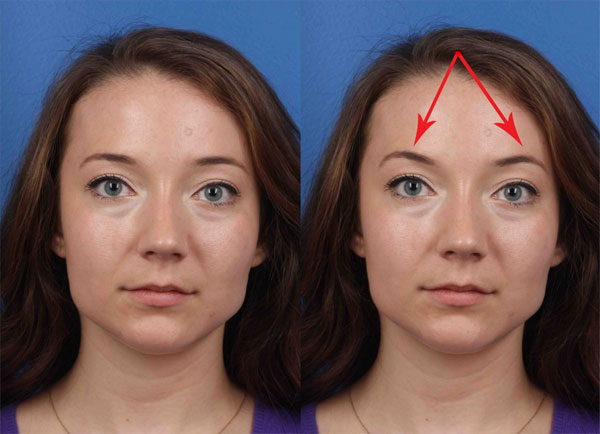
A brow lift or forehead lift reverses the effects of gravity and tightens the soft tissues of the forehead to restore a more youthful contour to your forehead skin, upper eyelids and eyebrows. There are various brow-lift methods, which involve different length incisions in different locations and, sometimes, an endoscope. A youthful brow at rest is positioned above the orbital rim, with a gradual arch laterally, and the lateral end or 'tail' of the brow located higher than the medial end. As one ages, it is common for the brow to assume a flat or horizontal position. If a sagging brow inhibits your facial expression, a brow lift is a time-tested method for rejuvenating the upper third of your face. Every year, thousands of people undergo successful brow-lift surgery and are pleased with the results.
How is a brow lift procedure performed?
Brow-lift
procedures have
evolved from
open techniques
to more complex
short incision
and endoscopic
techniques. A
brow lift
usually involves
incisions in the
hair-bearing
scalp, but
sometimes
incisions are
made in the
forehead and/or
the upper
eyelids.
Open brow lift.
Your surgeon
makes a long
incision across
the forehead,
either around
the hairline or
in one of the
creases of the
forehead, and
lifts the skin
away from the
underlying
tissues. The
surgeon then
loosens muscles
and removes fat.
He or she
removes any
excess skin,
pulls the
remaining skin
down, and
stitches the
brow into its
new position.
Other names
sometimes used
to describe open
brow lift
include classic,
coronal or
trichophytic
brow lift.
Endoscopic brow
lift. Your
surgeon will
insert an
endoscope (a
long, thin tube
with a light at
the end attached
to a video
camera) through
several tiny
incisions in the
scalp. This
allows your
surgeon to see
and work on the
various internal
structures of
the forehead.
The endoscopic
technique
requires very
minimal
incisions, but
it may not be
equally
beneficial for
all
patients.
Limited incision
technique. This
hybrid technique
of both
procedures is
non-endoscopic
with limited
incisions. It
uses a small
portion of the
ends of the
coronal
technique
incision to
elevate the
outside part of
the eyebrows
under direct
vision without
an endoscope.
The resulting
scars are hidden
in the temporal
hairline, even
in balding men
who have little
temporal hair
remaining. While
this procedure
does not address
the center area
of the brow, it
can reduce
wrinkles at the
corners of the
eyes, commonly
referred to as
'crow's feet.'
Since many
forehead-lift
procedures are
performed with
an upper
blepharoplasty,
the upper eyelid
incisions are
used to complete
the
forehead-lift
procedure by
treating the
'frown' lines
between the
eyebrows and
raising the
inside part of
the
eyebrows.
The type of brow
lift you undergo
will be based on
your facial
features and
aesthetic
preferences. The
goal of your
aesthetic
plastic surgeon
and the entire
staff is to help
you achieve the
most beautiful
and
natural-looking
results, as well
as to make your
surgical
experience as
easy and
comfortable as
possible.